Independent review · 25 July 2026

Site
Review

channingdaughters.com

Platform
Squarespace 7.1
+ Nexternal store
Pages published
427
Issues found
Dead links in the menu
3
Unfinished pages live
4
Pages left out of the sitemap
3
See the findings

Summary

The site is structurally sound and search engines can read it. The problems are maintenance: broken links, draft text left in production, and business details missing from the parts of the page machines read.

Most of it is small and quick to correct. The online store is a separate matter, covered at the end.

The complete list

Everything found

items, each verified on the live site. Filter by seriousness or by the part of the business it touches. The four with the largest effect are explained in detail below.

Seriousness
Area

    In detail

    The four that matter most

    Evidence for the items with the largest effect on people reaching the tasting room, captured from the live site.

    01

    The way in is broken

    The most important button on the homepage — the one that says Plan Your Visit — does not lead to the visit page.

    It points at /visiting-us, an address that no longer exists. The reason nobody has caught it is that nothing appears to break. There is no error message and no missing-page screen. Squarespace serves the homepage instead.

    A visitor clicks Plan Your Visit, the screen changes, and they are back on the homepage they started from. They never reach hours, directions or booking.
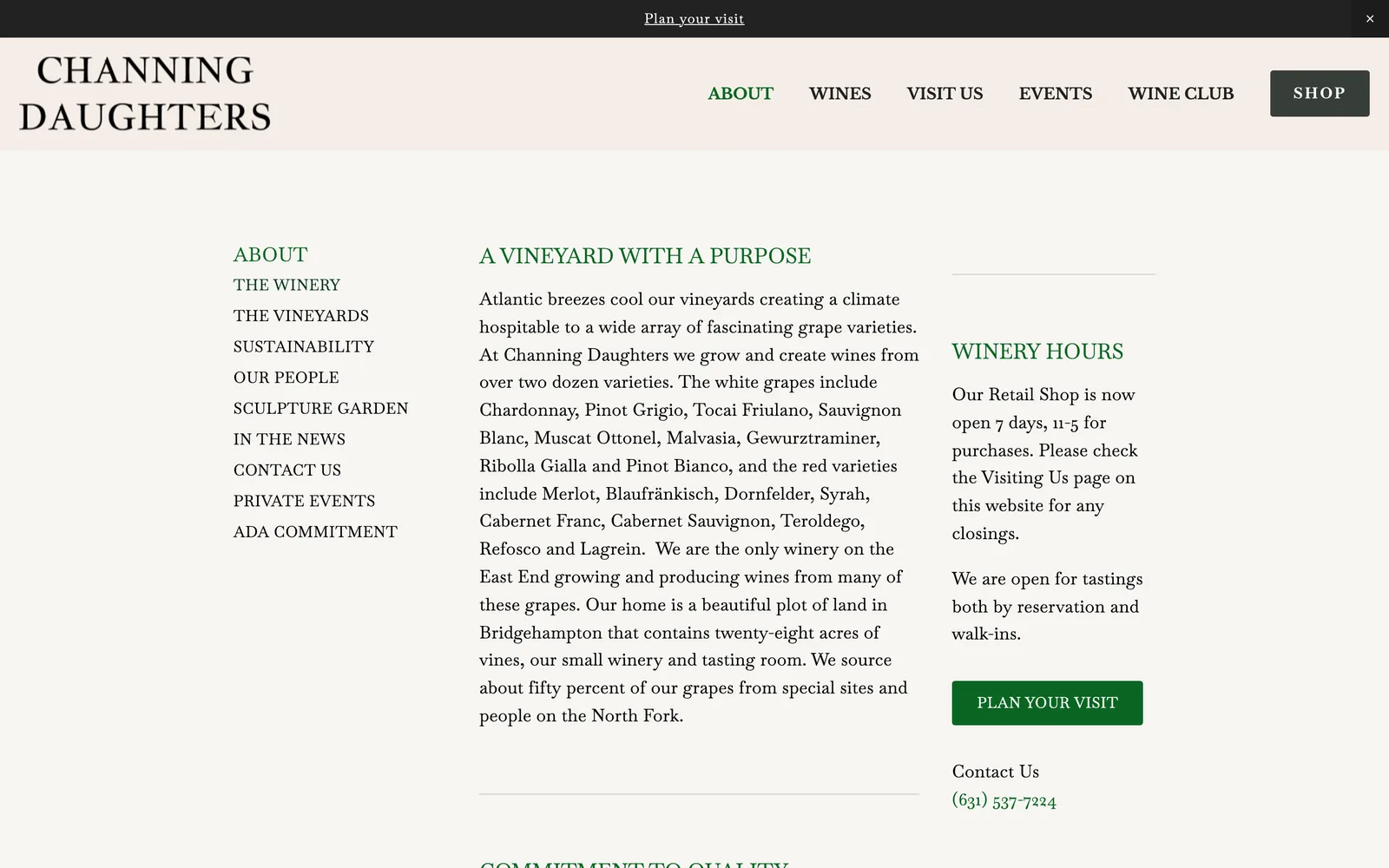
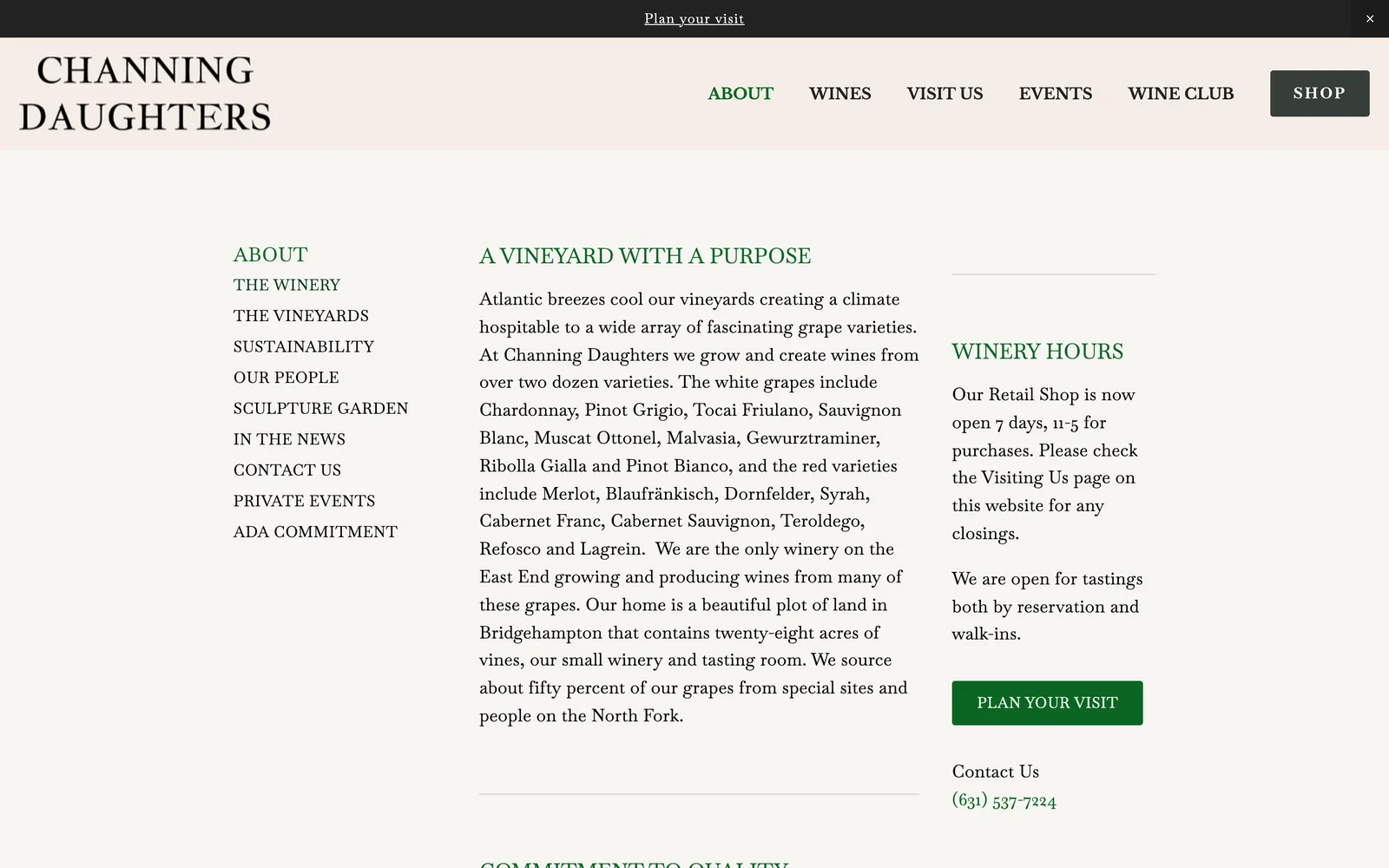
    The page shown after clicking Plan Your Visit — homepage content, including the Winery Hours block. Homepage content, served under a 404
    What visitors get after clicking the main call to action. Search engines are told the page does not exist. People are shown the homepage.

    On that same screen, the Winery Hours panel reads:

    Our Retail Shop is now open 7 days, 11-5 for purchases. Please check the Visiting Us page on this website for any closings.

    The site is directing people to the page whose address is broken. Anyone following that instruction ends up in the same loop.

    The black bar across the top of every page has the same problem. It holds two links stacked on top of each other. The words Plan your visit are linked correctly and work. The bar behind them is a second link pointing at an address that no longer exists.

    The words cover about seven percent of the bar. The rest of the dark strip, either side of them, is the dead link.

    The announcement bar across the top of the site, with the clickable regions marked. Dead link — 93% of the bar Works — 7%
    The same bar, with the two overlapping links marked. Anyone aiming for the bar rather than precisely at the words lands on a page that doesn't exist. On a phone, where the target is a thumb rather than a cursor, the odds of missing are considerably worse.

    What this costs

    Every visitor who does exactly what the site asks — click the main button — fails to reach hours, directions, or booking. Google has had the retired address indexed against searches for tasting room hours, so some people never even start on the homepage.
    Effort to fixMinutes
    02

    Pages that look unfinished

    Draft text made it into production and stayed there.

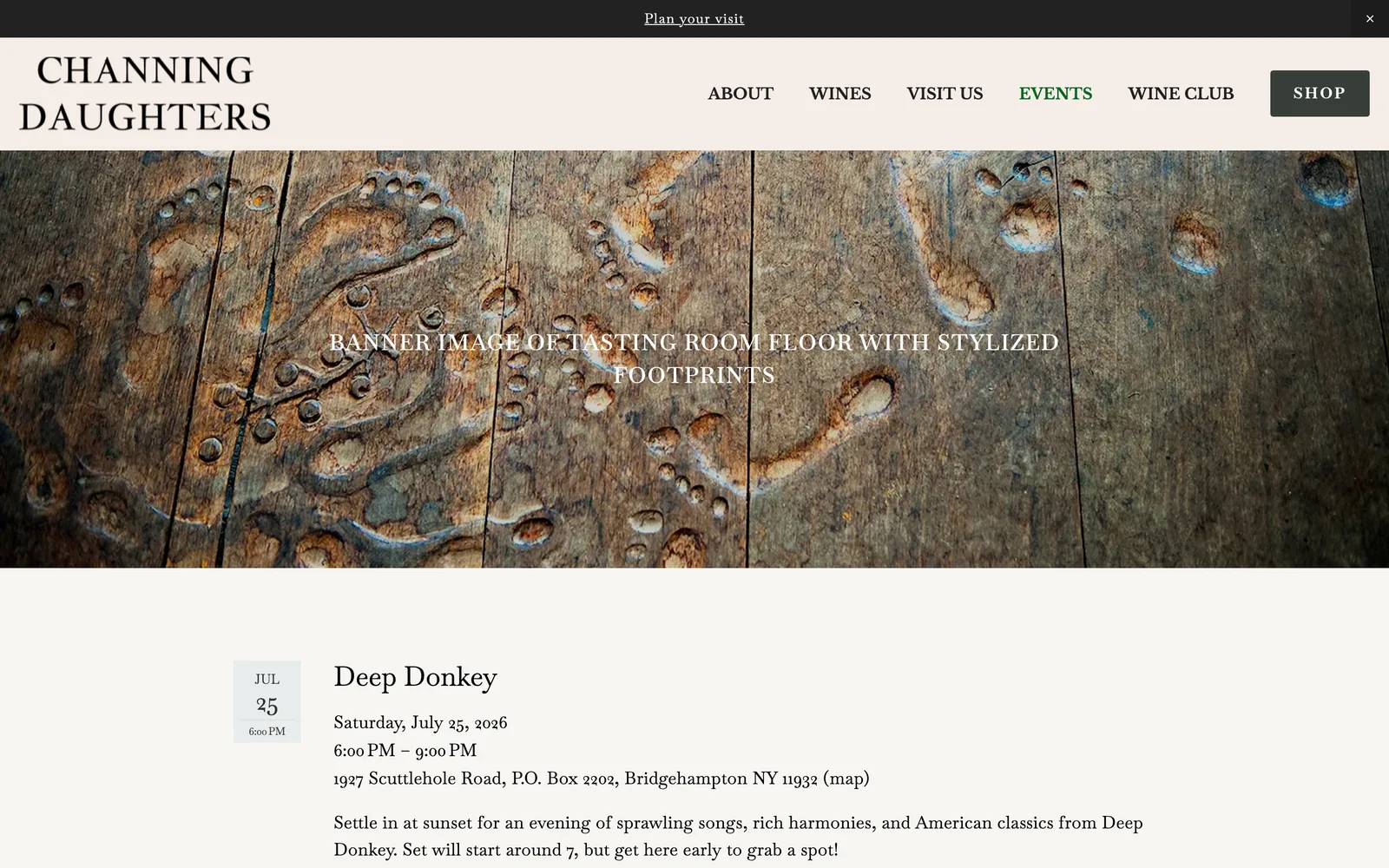
    The Events page has a note-to-self where its headline should be. It is set in the same serif as the rest of the site, in white, over the photograph, so it reads as finished design until you actually read it.

    The Events page hero showing the placeholder headline BANNER IMAGE OF TASTING ROOM FLOOR WITH STYLIZED FOOTPRINTS. Live on the site today
    The Events page, as it appears right now. The headline is the instruction someone typed while building the page.

    Elsewhere, a page is still carrying the Latin filler text Squarespace ships with a blank template — "It all started when… Vivamus a ante congue…" — and it is listed in the site's own index of pages for search engines to find. Three more abandoned draft pages sit alongside it.

    The Wines menu has a related problem. It points at an old copy of the entire wine catalogue, left over from a previous version of the site — roughly 21,000 words duplicating tasting notes that already live on their own pages. The real wine section, ninety-nine individual pages built properly, isn't linked from the homepage at all.

    What this costs

    Placeholder text on a page about events looks bad to anyone who lands on it. Search engines also read unfinished pages as a signal about the site as a whole, and the wine catalogue is currently competing against its own duplicate.

    Effort to fixAn afternoon
    03

    Invisible where it counts

    Several things that work perfectly for visitors don't exist at all as far as search engines are concerned.

    Behind every website is a small machine-readable card describing the business — name, address, phone, hours, social accounts. It's what Google reads to decide whether to show you in the map results, and what AI assistants read when someone asks where to go wine tasting in the Hamptons.

    On this site that card exists, and the business name field is empty. So are the social accounts, the opening hours, and the map coordinates — despite all of that information being visible elsewhere on the page for humans to read.

    The site's own business record, read live

    "@type"    : "LocalBusiness"
    "name"     : ""            ← blank
    "telephone": absent
    "sameAs"   : []            ← no social accounts
    "openingHours": absent
    "geo"      : absent

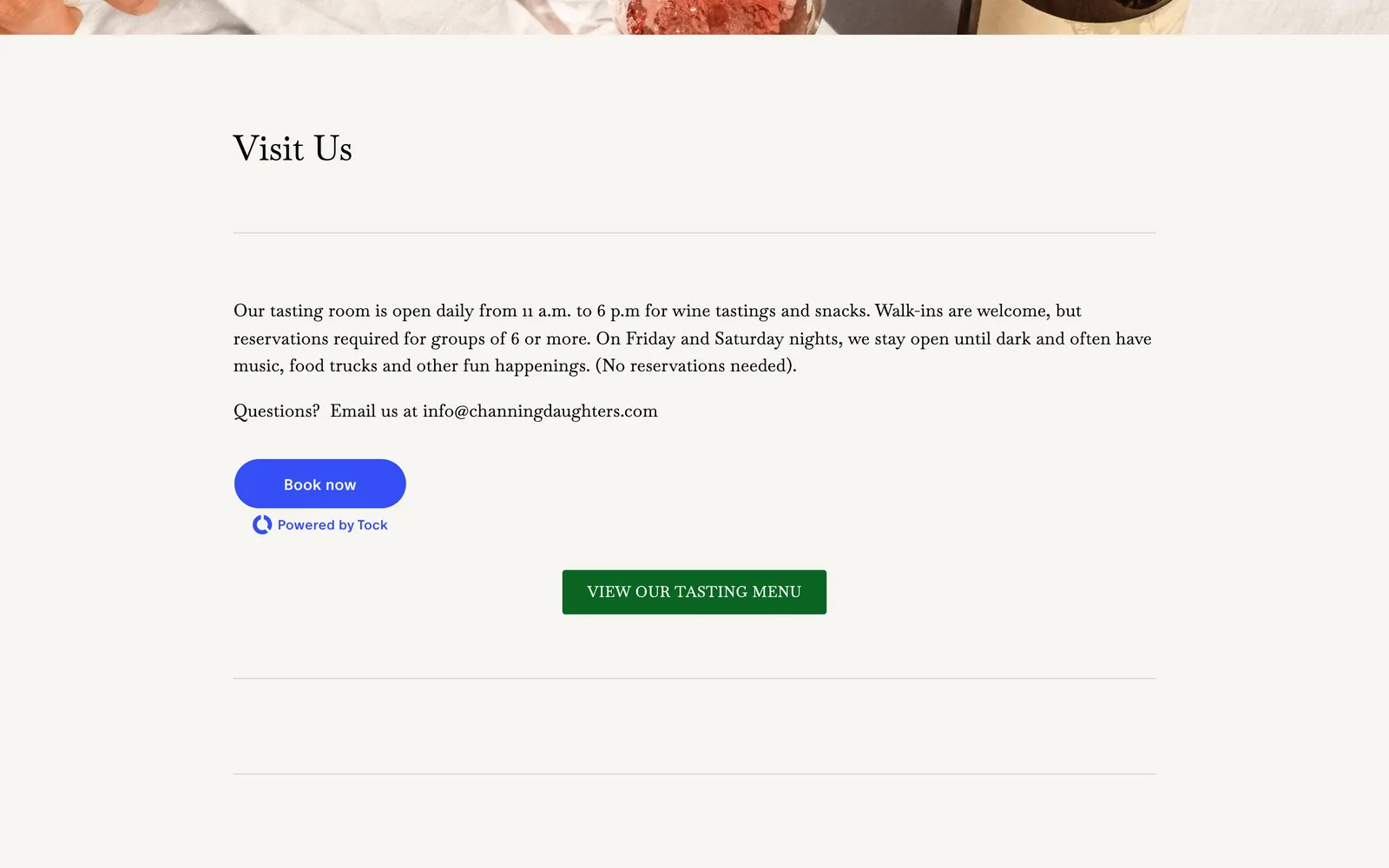
    The same pattern repeats with the booking button. There is one — Tock, working, on the visit page. But it's drawn onto the page by a script after loading, which means search engines and AI assistants don't see a booking option here at all. That is very likely why searches like book a tasting at Channing Daughters surface tour operators and travel marketplaces instead of the winery's own page.

    The Visit page showing a working blue Book Now button powered by Tock. Works for people · invisible to search
    The booking button on the visit page. It works. It's also the only booking path on the site, and it's the one thing a search engine can't find. The contact map and the private events enquiry form have the same problem.

    The tasting menu has a version of this too — the page is live and linked, but it was never added to the site's index, so it isn't eligible to appear in search at all. Four other pages in the navigation are in the same position.

    A smaller item, and low effort to correct: most pages have no preview image attached, so links shared to Instagram, Facebook or a text message arrive as plain grey boxes. On the Events page the preview text is currently the photographer's note, "banner image of tasting room floor with stylized footprints."

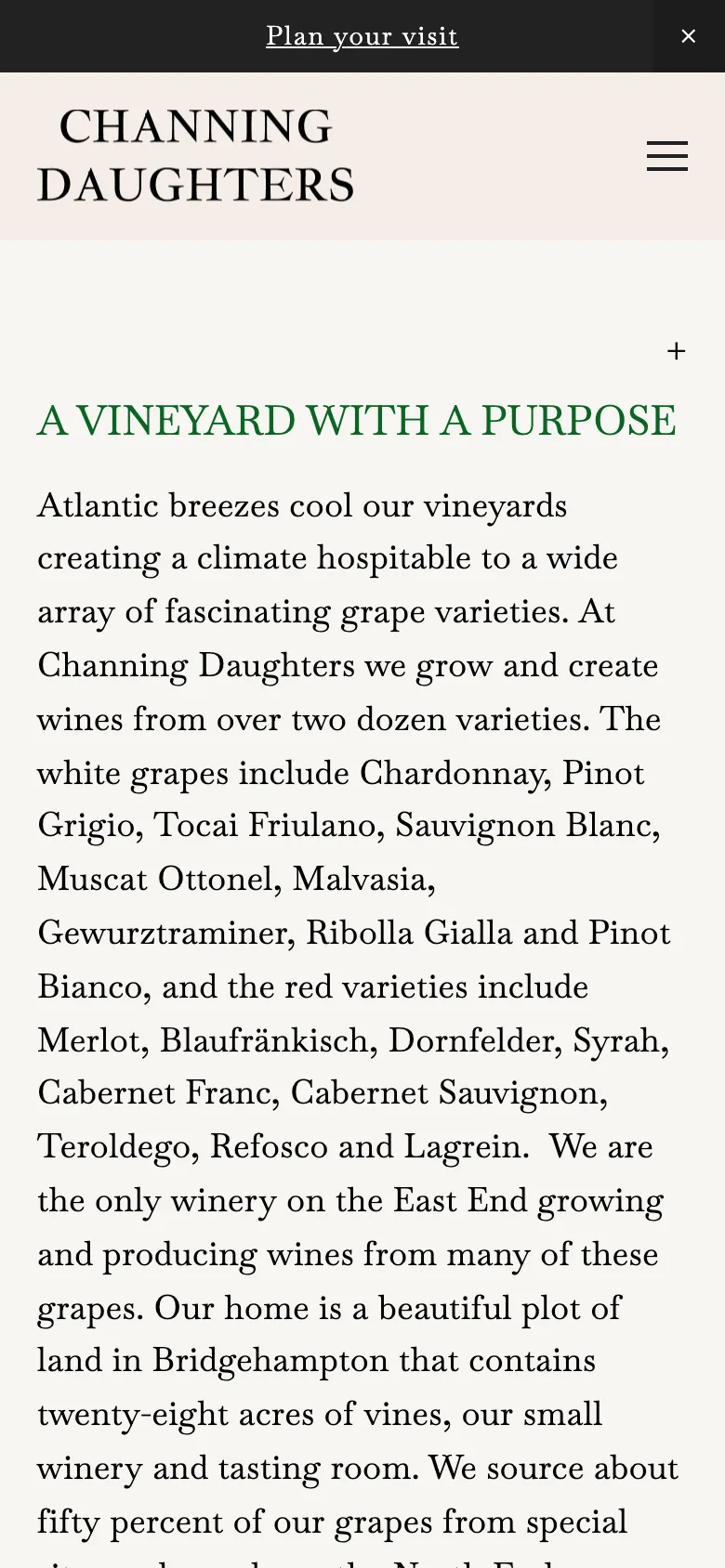
    On a phone, the first screen is brand copy about grape varieties. Hours, address and booking all come after scrolling.

    The homepage on a phone, opening with a paragraph about grape varieties.
    The first thing a phone visitor sees.
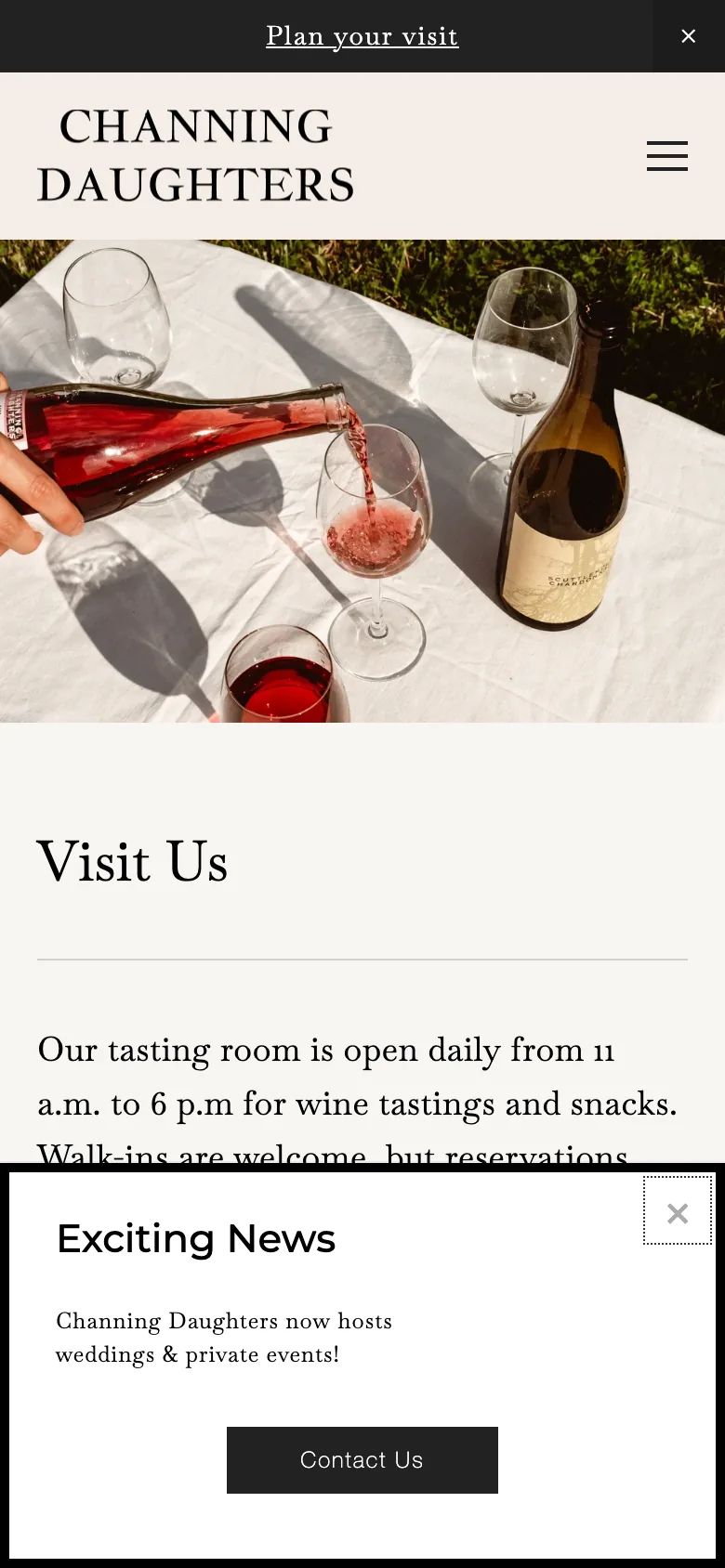
    The visit page on a phone with a promotional overlay covering the hours.
    The visit page, on arrival, with the wedding promotion over the hours.

    What this costs

    A blank business record keeps you out of the map results that decide wineries near me. An invisible booking button hands that search to Expedia and the tour companies. Together they mean the winery is competing for its own name against people reselling it.

    Effort to fixSettings, then a focused pass
    04

    The shop is a separate conversation

    Worth raising, but its own project, and not one to start this month.

    The store runs on Nexternal, a separate platform from the main website, on its own web address. Google can read it: product pages, categories and the wine club signup are all in the search index.

    The problem is that they rank poorly. Search a Channing Daughters wine by name and the results are Astor Wines, Vivino and Wine-Searcher, with the winery's own shop nowhere near the top. The bottles are for sale in a dozen places that outrank the people who made them.

    The main Channing Daughters website.
    The website
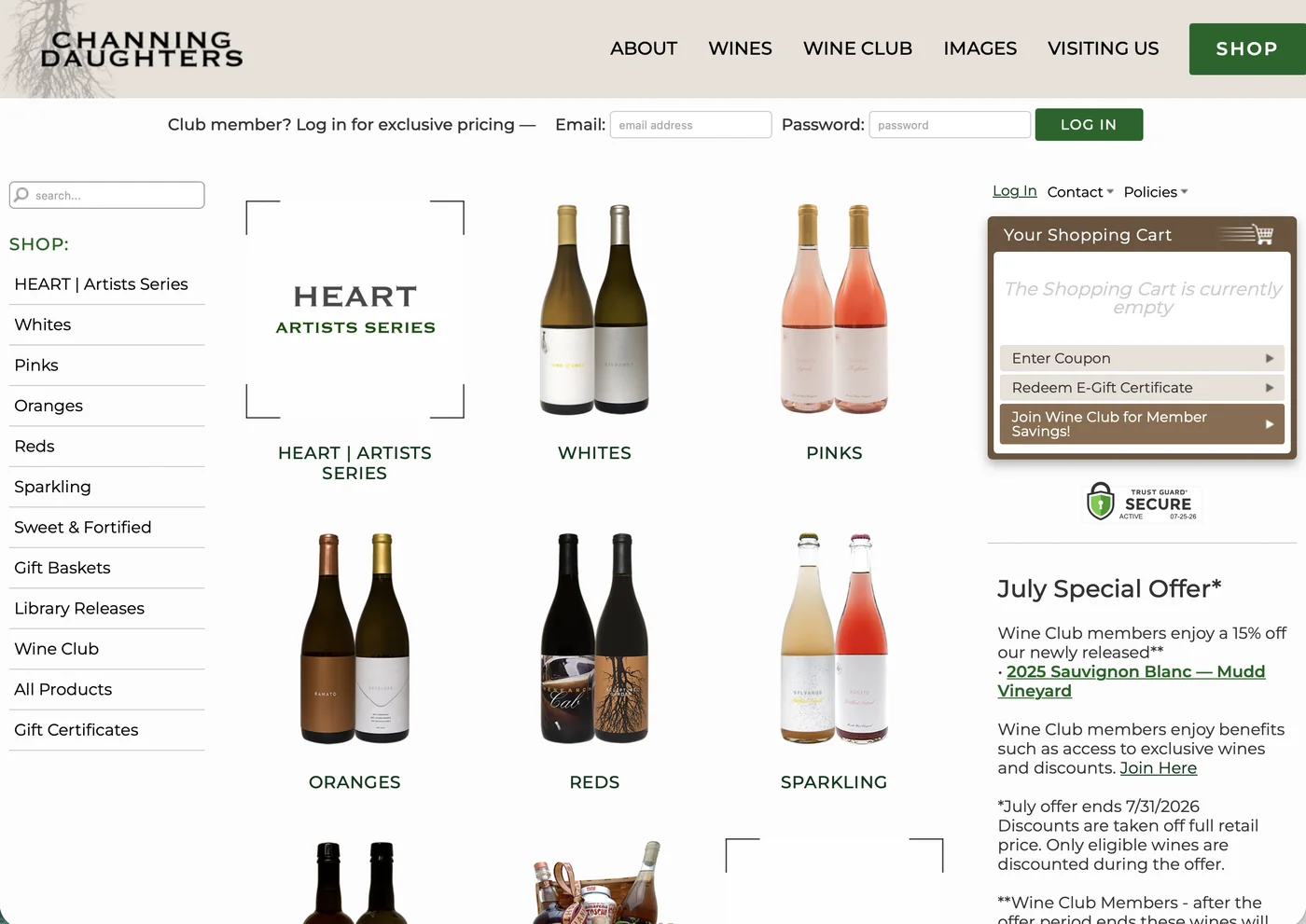
    The Nexternal storefront as a customer sees it, showing the wine categories.
    The shop, one click later

    There is a presentation gap as well. A customer who clicks Shop arrives somewhere that looks like a different company: different typefaces, different colours, none of the character of the main site. That is not a fault of the platform, which is built for wine compliance and shipping rules rather than for looks.

    The first step is not a rebuild. It is working out why a decade-old storefront on a separate address loses to retailers for the winery's own labels, which is a mix of how the product pages are written and how little of the main site's standing reaches them. Anything beyond that, whether closer visual alignment or moving the store, is a project with a budget attached and should be decided on its own merits.

    What this costs

    Someone searching for a specific bottle buys it from a retailer instead, at a lower margin and with no customer relationship attached. The press coverage the winery has earned over the years builds standing for the main site, not for the shop.

    Effort to fixIts own project

    Before anything gets published

    A few facts that need confirmation

    These need answers from inside the business. Guessing at any of them risks publishing something wrong under the winery's name.

    1. What are the tasting room hours?

      The site gives three different answers. The homepage says the retail shop is open 7 days, 11–5. The visit page says the tasting room is open daily 11–6, staying open until dark on Friday and Saturday. If the shop and the tasting room keep different hours, the site should say so directly.

    2. Where exactly should the map pin sit?

      The address used across the site includes the P.O. Box, which confuses mapping software. I'd like the tasting room entrance pinned deliberately rather than approximated from a postal address.

    3. Is anything already planned for the shop?

      If a move off Nexternal is being discussed, some of the recommendations here change shape and a few become pointless. Worth knowing before work starts.

    4. Who has access to the Google Business Profile?

      The listing that appears in maps and local results cannot be checked from outside. It is often the largest single factor in local visibility, and usually quick to improve once someone has access.

    Proposed plan

    A three-month sequence

    Repairs happen immediately. The larger pieces follow in an order that keeps the site earning while the next stage is built.

    1. Phase one Week 1

      Repairs

      I handle the short items directly: the visit path, the placeholder and draft pages, the wine menu, the business record, the sitemap gaps and the link previews. Around sixty percent of the list closes here.

      • Broken links
      • Placeholder text
      • Business record
      • Sharing previews

      By the end of it The main call to action works, the site stops looking unfinished, and you're eligible for local results.

    2. Phase two Week 2 – Month 2, week 2

      Design and content

      Design work on the new marketing site, alongside the content the current one is missing: the visit page, private events and the wine pages. The outstanding questions get answered in this period as well.

      • Design
      • Photography direction
      • Copy
      • Fact confirmation

      By the end of it A site ready to build against, with the thin pages properly written.

    3. Phase three Month 2, weeks 3–4

      Redesign and relaunch

      Build and launch the new marketing site, carrying over everything fixed in phase one so none of it is lost in the move. Redirects handled so existing search positions transfer rather than reset.

      • Build
      • Redirects
      • Launch

      By the end of it A site that reflects the winery, with the repairs built in rather than bolted on.

    4. Phase four Month 3

      The shop

      Two routes, and the recommendation depends on what you want the point of sale and wine club to do:

      Route A

      Move off Nexternal to a modern platform that integrates with a modern POS and digital marketing tools, and still retains wine club and mailing list integration.

      Route B

      Keep their backend and work with their developers on access to it, while I build a new storefront that matches the site, so the shop stops looking like a different company.

    Phase one is short enough that it's worth doing regardless of what's decided about the rest.

    For the record

    How this was checked

    What was examined

    All 427 published pages were inventoried. Twelve page types were examined in full: homepage, visit, events, an individual event, a wine page, the wine club, private events, contact, a staff profile, a recipe, a press article and the events index.

    How it was verified

    Every finding was confirmed against the live site on the day of writing, and the screenshots are from that session. Where something depended on how a page behaves for a real person, I opened it in a browser and used it rather than trusting an automated reading.

    What I'm not claiming

    Page speed figures come from simulated testing rather than measurements of real visitors, so treat them as directional. Review counts, map listing details and the full picture of who links to the site require access I do not have. Those are flagged as questions rather than findings.